 How to use
Full guide › Draw odds guide
Building conditions (and/or)
Points to watch when connecting the cards you want with “and” and “or”. Depending on how you connect them, combinations you did not intend can also count as a success.
- A common misunderstanding Suppose you pick two copies of "Professor's Research" and two of "Poké Ball" as cards to draw, join the identical cards with "or" and put "and" between the two kinds, as in the image below.
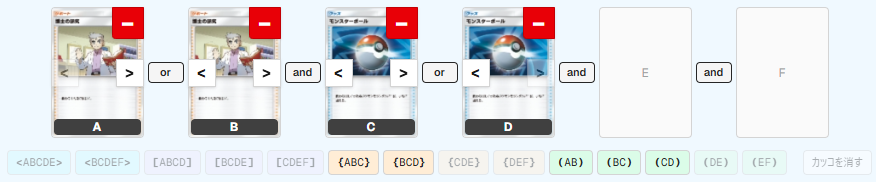
You might expect this to mean at least one "Professor's Research" and one "Poké Ball", but it does not.
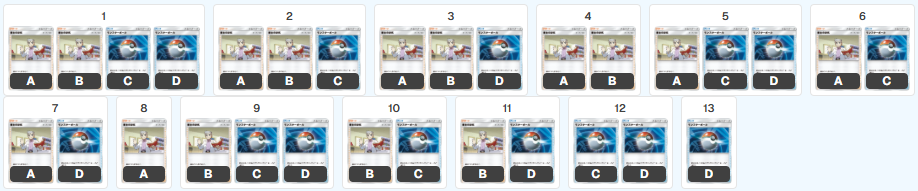
In reality it allows patterns of "only one of the two kinds, and in the worst case a single card". This is because "and" takes priority over "or", just as × and ÷ take priority over + and − in arithmetic.
As a result the condition groups into "Professor's Research" / "Professor's Research and Poké Ball" / "Poké Ball". Put simply, you can think of the middle two cards as having merged into a single card, a "Professor's Ball". The condition then means it is enough to draw any one of "Professor's Research", "Professor's Ball" or "Poké Ball".
To get the combination you intended, at least one of each, group the identical cards with brackets.
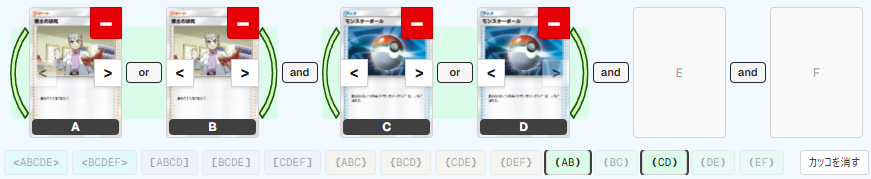
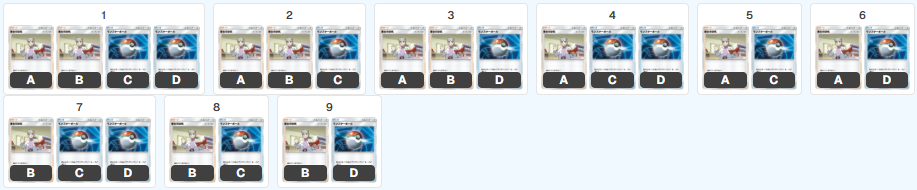
Now the condition matches the combination you were aiming for.
- How far "or" reaches
The example above focused on the priority of "and", but the reason a condition can collapse into something like "a single Poké Ball" is how far the influence of "or" reaches. In that first, incorrect condition it feels intuitive that the middle two cards (B and C) joined by "and" must either both be there or both be absent.
In other words, "or" means "if this one is there, anything goes for the rest, even none of them".


As the images show, however complex the condition is, if there is a card joined with "or" at the end, it counts as a match no matter whether the cards to its left are present or not. So use brackets to keep the reach of each "or" under control.
Related how-to